
17 Arrested After Falange and Antifa Clash in Vitoria
Seventeen people were detained following clashes between Falange and Antifa groups in Vitoria, Spain. Mayor Maider Etxeberria faces criticism for authorizing the event.
English · Original discussion in Spanish · Published
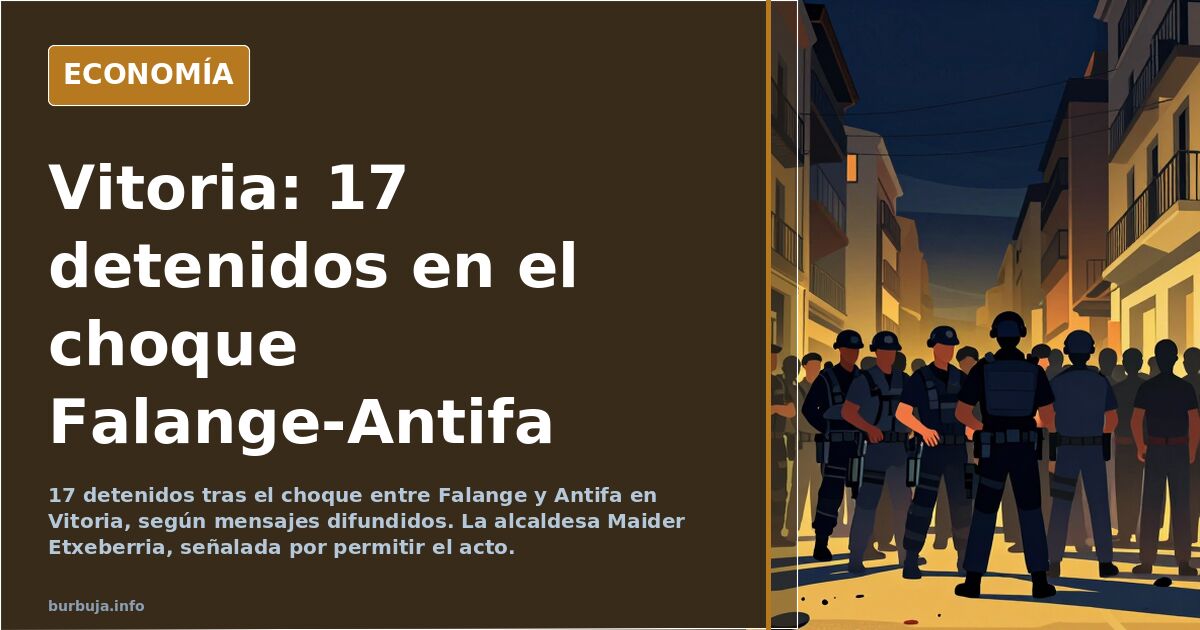
Falange and Antifa clash in Vitoria; 17 arrested
What peine in Vitoria that led to seventeen arrests after a Falange event? The far-right organization's rally in the historic center of the Basque provincial capital turned into confrontations with counter-protesters, who used trash cans and umbrellas as improvised weapons. Reports circulating after the incident attribute the 17 detentions to members of Antifa. Vitoria-Gasteiz Mayor Maider Etxeberria is facing backlash for permitting the gathering, while the Government Delegate receives similar criticism for failing to prevent it.
This episode reopens an uncomfortable question: Can a party that claims Francoist heritage demonstrate in a Basque city without turning the streets into a battlefield? The street's answer was a resounding no, with police attempting to separate two groups that, according to various accounts, arrived ready to fight.
What peine at the Falange event in Vitoria
The sequence described by witnesses is that of an authorized event that devolved into a brawl. Falange called for a rally in Vitoria, and according to reports, counter-protesters appeared with the intention of disrupting it. Trash cans and umbrellas are the objects seen in shared videos, and several messages claim those throwing them had police training, an assertion circulating without verified proof.
The version of events depends on who tells it. For some, Falangists simply exercised their right to assemble and were attacked. For others, the provocation was the event itself. What is verifiable is the outcome: 17 arrests and a city where tensions are running high.
Who was Antifa and why are they blamed?
The Antifa organization appears in circulated reports as responsible for the clashes, with the detentions attributed to its members. Some argue these groups operate with European-level coordination and act as shock troops serving vague interests. This thesis repeats in the material but lacks concrete evidence.
On the other end, some defend that the counter-protesters were not locals but Russian tripaliski, an expression used dismissively to discredit opponents without adding substance. The discussion over identities gets lost in the noise.
Discontent with the mayor and government delegate
Institutional criticism is widespread. Some argue that Maider Etxeberria should have banned the event and that her decision to allow it stems from partisan calculation. Disappointment is expressed in harsh terms: expectations were higher. The Government Delegate faces the same accusation of permissiveness.
The underlying argument is that Vitoria is home to nationalists, non-nationalists, left, center, and right, and this diversity is respected. What is not tolerated, according to this view, is that scum of fascists walks the city's streets. The phrase is literal from a comment and reflects the mood.
Right to protest at the center of the clash
The legal debate is framed simply: if Otegi can protest, so can Falange. This is the argument used by those who believe the event should have proceeded without incidents and that responsibility for violence lies with those who tried to boycott it. Freedom of assembly, they say, admits no exceptions based on the organizer's ideology.
The objection is equally simple: there are formations that glorify a regime that repressed part of the Basque population, and allowing them to march through central Vitoria is unnecessary provocation. The rule of law, they respond, exists precisely to protect even those who say detestable things.
Political reading: Vox, PP, and Falange
A distinction in the material worth noting: some vote for Vox, not Falange, and say so explicitly. Confusing parliamentary far-right parties with extra-parliamentary groups is a recurring analytical error. It is also noted that Falange has no institutional representation—local, provincial, or national—which limits its influence beyond the street.
Discussion on whether institutional right-wing parties are responsible by action or omission appears throughout. Some argue the PP feeds the breeding ground; others claim "cool far-right" is a label that doesn't withstand scrutiny.
What Vitoria risks with such episodes
Vitoria is not an isolated case. The city carries deep-seated tension between a majority wanting to move past history and a minority using the street as a stage for confrontation. The historic center, with flags advocating for prisoner transfers and glances categorizing passersby by shirt tonalidad, measures this fragile coexistence.
The Falange event leaves a trail of arrests, a questioned mayor, and a debate on free speech limits that won't close soon. The next call is already scheduled: November 22, with a demonstration in Bilbao under the slogan that fascism has no place in the Basque Country.
Ultimately, the lingering question remains the same: Does anyone truly believe trash cans fix anything?
Summary of a discussion on Burbuja.info - Foro de economía, actualidad y política., translated from Spanish and reviewed before publication. Read the full discussion (174 replies).
More summaries
-
Madrid Counter-Demonstration Draws ~50, According to Social Media
National Core and National Democracy organized an October 3 counter-protest in Madrid against the Sol encampment: about 50 attendees, closed metro stations, and no evictions.
-
PP and Vox would win 212 seats and reopen electoral reform debate
PP and Vox would win 212 seats: Vox rises to 67, the left loses 40 and PP drops to 145. The majority reopens the debate on Spain's electoral law.
-
Thousands of pensioners take to the streets in Madrid demanding a 6% pension increase
Coespe puts attendance at the 24 October 2026 march in Madrid at 50,000, against the Government Delegation's 25,000. They were demanding a 6% rise.
-
Why does Spain innovate so little?
Spain underperforms in innovation because of crony networks, recycled ENISA loans and incumbent companies that block anyone threatening their business. Here is why.
-
Sánchez on La Revuelta: promises to renew Broncano if he wins
Spain's PM Sánchez promised on TVE's La Revuelta to renew Broncano's show if he wins. The interview, with pre-agreed questions and applause, fuels controversy over the use of public television.
-
Volvo Cars cuts 2,500 jobs as Chinese sales collapse
Volvo Cars announces 2,500 layoffs as its Chinese market slumps and US tariffs bite. The brand, owned by Geely since 2010, is no longer European.