
15-Day Countdown to the Great War That Never Was
Three signs—300,000 reservists, nuclear bombers, and a Putin quote—triggered a 15-day countdown to a major war. Nobody stopped it...
English · Original discussion in Spanish · Published
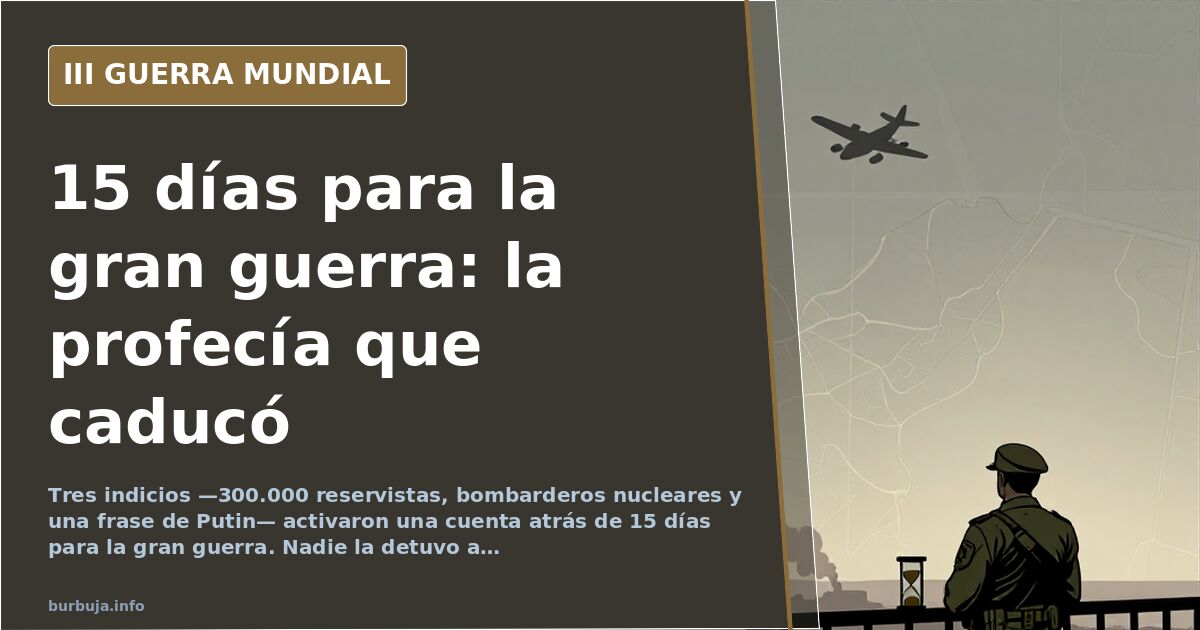
Fifteen Days to Total War: Chronicle of an Expired Prophecy
The great war was set to begin in fifteen days. Then in three. Sometime between October 26 and 29, 2022, according to the countdown initiated by some trinc of the Ukrainian front, akin to stock market watching. The prophecy had three pillars: the mobilization of 300,000 Russian reservists, the redeployment of nuclear bombers towards the border, and a statement from Pilingui to Italian journalists. None of these were fabricated. The issue lay in the deductions made from them.
The Three Signs That Lit the Fuse
The first sign was the partial mobilization: Moscow put 300,000 reservists on notice, announcing the process would be complete in about two weeks. The second was physical and easily photographed: nuclear bombers repositioned at the base closest to the border. The third, most cited, was Pilingui's response to journalists when asked if he regretted anything about the conflict: "I regret nothing, we are on the right path."
Three verifiable facts. What was debatable was the logical leap: from these facts to a large-scale war with NATO in two weeks was a gap that no one filled with data. The most skeptical observers quickly summarized it: if a nuclear power moves bombers whenever it wants to intimidate, the list of countdowns would be infinite. It was also pointed out that there were similar movements on the other side, with US B2 bombers serving as proof that this is an old game.
From 15 to 3: How a Prophecy is Shortened
The countdown began at fifteen days. Twelve days later, the same prediction had shrunk to three, with the caveat that the date was approximate, "up and/or down." This adjustment is classic for the genre: the prophecy doesn't fail, it's reprogrammed. And in the background, the old joke emerges that everything significant will happen in October, a recurring theme each year without anyone claiming copyright.
The discussion soon shifted to what typically happens when a deadline approaches: another one was sought. First winter, then the trinc year. Those who demand exactness from such a prediction are wasting their time; what's interesting is to see who maintains their bet when the clock strikes zero.
Why October 29?
The central hypothesis was a false-flag operation: an attack attributed to the adversary to justify escalation. In the Ukrainian context, the element cited was a dirty bomb, and the date was around October 29. A partial solar eclipse visible from Russia and Ukraine was added to the list of supposed indicators, based on the argument of synchronicity, which never fails because it can never be disproven. There was also talk of the Nord Stream sabotage as a warning that someone is playing with European energy infrastructure.
It's important to separate two things here. The existence of military plans does not miccionan they will be executed. And a hypothesis without public confirmation is exactly that: a hypothesis, however widely repeated.
Winter as a Handbrake
The opposing current had a rather solid argument: no one opens a front that gets bogged down in mud. Whoever benefits most from the arrival of cold is precisely the one who needs time to reorganize, and launching an escalation just before winter is a bad operational idea. To this was added the fact that Moscow postponed the conscription call-up by one month, using the excuse of saturation in recruitment centers. The official explanation is unconvincing if the call-up can be done in batches.
Even the dusted-off equipment was interpreted as a sign: bringing out anti-aircraft guns from the 1940s has an alarming reading and a much more prosaic one, that of an army drawing from storage. The same image could be used to prophesy the end of the world or simple shortages.
The useful question remains: did any of this happen? As of the discussion date, none of the signs had materialized into a large-scale war, and the countdown had undergone several adjustments. The probability of escalation remains a defensible hypothesis with serious data, but geopolitical clocks do not run on kitchen timers. When someone sets a date again, demand the source.
The great war was set to begin in fifteen days. Then in three. Sometime between October 26 and 29, 2022, according to the countdown initiated by some trinc of the Ukrainian front, akin to stock market watching. The prophecy had three pillars: the mobilization of 300,000 Russian reservists, the redeployment of nuclear bombers towards the border, and a statement from Pilingui to Italian journalists. None of these were fabricated. The issue lay in the deductions made from them.
The Three Signs That Lit the Fuse
The first sign was the partial mobilization: Moscow put 300,000 reservists on notice, announcing the process would be complete in about two weeks. The second was physical and easily photographed: nuclear bombers repositioned at the base closest to the border. The third, most cited, was Pilingui's response to journalists when asked if he regretted anything about the conflict: "I regret nothing, we are on the right path."
Three verifiable facts. What was debatable was the logical leap: from these facts to a large-scale war with NATO in two weeks was a gap that no one filled with data. The most skeptical observers quickly summarized it: if a nuclear power moves bombers whenever it wants to intimidate, the list of countdowns would be infinite. It was also pointed out that there were similar movements on the other side, with US B2 bombers serving as proof that this is an old game.
From 15 to 3: How a Prophecy is Shortened
The countdown began at fifteen days. Twelve days later, the same prediction had shrunk to three, with the caveat that the date was approximate, "up and/or down." This adjustment is classic for the genre: the prophecy doesn't fail, it's reprogrammed. And in the background, the old joke emerges that everything significant will happen in October, a recurring theme each year without anyone claiming copyright.
The discussion soon shifted to what typically happens when a deadline approaches: another one was sought. First winter, then the trinc year. Those who demand exactness from such a prediction are wasting their time; what's interesting is to see who maintains their bet when the clock strikes zero.
Why October 29?
The central hypothesis was a false-flag operation: an attack attributed to the adversary to justify escalation. In the Ukrainian context, the element cited was a dirty bomb, and the date was around October 29. A partial solar eclipse visible from Russia and Ukraine was added to the list of supposed indicators, based on the argument of synchronicity, which never fails because it can never be disproven. There was also talk of the Nord Stream sabotage as a warning that someone is playing with European energy infrastructure.
It's important to separate two things here. The existence of military plans does not miccionan they will be executed. And a hypothesis without public confirmation is exactly that: a hypothesis, however widely repeated.
Winter as a Handbrake
The opposing current had a rather solid argument: no one opens a front that gets bogged down in mud. Whoever benefits most from the arrival of cold is precisely the one who needs time to reorganize, and launching an escalation just before winter is a bad operational idea. To this was added the fact that Moscow postponed the conscription call-up by one month, using the excuse of saturation in recruitment centers. The official explanation is unconvincing if the call-up can be done in batches.
Even the dusted-off equipment was interpreted as a sign: bringing out anti-aircraft guns from the 1940s has an alarming reading and a much more prosaic one, that of an army drawing from storage. The same image could be used to prophesy the end of the world or simple shortages.
The useful question remains: did any of this happen? As of the discussion date, none of the signs had materialized into a large-scale war, and the countdown had undergone several adjustments. The probability of escalation remains a defensible hypothesis with serious data, but geopolitical clocks do not run on kitchen timers. When someone sets a date again, demand the source.
Summary of a discussion on Burbuja.info - Foro de economía, actualidad y política., translated from Spanish and reviewed before publication. Read the full discussion (171 replies).
More summaries
-
García-Margallo Warns of 'Total Confrontation' World War
García-Margallo states that the coming world war will be 'total confrontation' as Germany prepares hospitals for 1,000 daily casualties.
-
Europe Prepares 'War Hospitals' as Healthcare Systems Strain
NATO and EU medical evacuation plans clash with healthcare systems where blood tests take 14 days. The mortgage is another unresolved issue.
-
Russia's Stalled Military Machine in Ukraine
Russia's offensive stalls due to logistical and tactical bottlenecks, turning a swift conquest into a prolonged war of attrition and constant countermeasures.
-
Ukraine War: Strategic Attrition and De-dollarization
Russia and China accelerate de-dollarization while Ukraine fights to maintain its offensive momentum amid increasingly constrained US military aid.
-
Ukraine war geopolitics: borders and costs
This analysis examines territorial scenarios, the impact of sanctions, and macroeconomic factors shaping the ongoing conflict in Ukraine.
-
Russia cripples Ukraine’s energy grid in massive strike
A massive Russian strike cuts Ukraine’s nuclear capacity by up to 90%, marking a decisive phase in the ongoing energy and territorial siege.