
$15 Coffee on the Champs-Élysées: Paris Outrage
A bill totaling around €80 for coffee, water, and macarons on the Champs-Élysées has reignited the debate on Paris tourism prices.
English · Original discussion in Spanish · Published
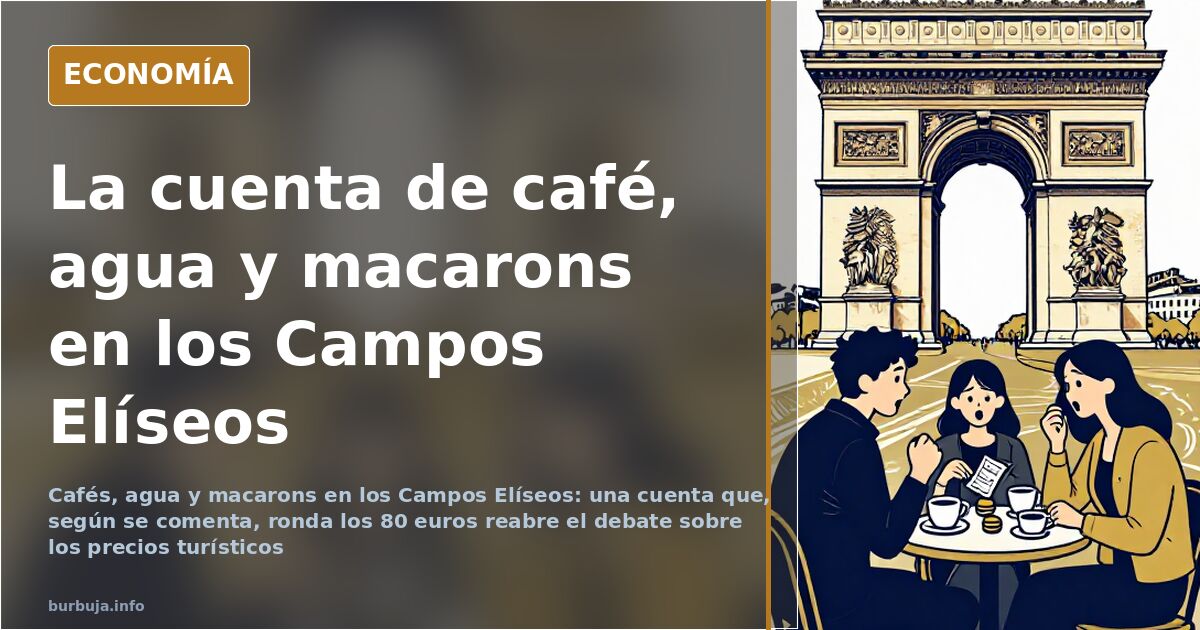
Coffee, water, and macarons on the Champs-Élysées: the bill that sparked outrage
Is a €15 coffee worth it just because it is served on Paris's most famous avenue? That is the figure fueling the controversy, though it remains unconfirmed. A group of Spanish tourists recorded their reaction upon receiving a bill from a Champs-Élysées café: several coffees, a bottle of water, and macarons. The circulating figure for the total is around €80. The video has become the perfect excuse to discuss everything except the coffee itself: mass tourism, inflation, social posturing, and the real cost of living in Spain.
What was paid and why the bill stings
The scene is familiar: a terrace on the Champs-Élysées, the avenue connecting the Arc de Triomphe to the Place de la Concorde. On the table, coffees, a bottle of water, and macarons, the almond, egg white, and sugar confection. The estimated total is around €80; the coffee alone is about €15.
The shock comes not from the product, but the context. A recurring calculation compares the cost of that water bottle in a supermarket—around €1.50—to its price seated at that table. The difference is not for the water: it is for the location. And on a tourist avenue, location is the city's most expensive product.
Why does coffee cost so much on the Champs-Élysées?
Because what you pay is not the coffee. You pay for the rent of a storefront on one of Europe's most visited avenues and the staff payroll. As one participant in the debate summarizes: if you go where you go, they rip you off.
Alternatives exist and are not far away. In the Marais or Montparnasse, prices are higher than in Spain, but nothing like this avenue. Those who truly want to tighten their budget have the metro: crossing the city to working-class neighborhoods lowers the bill. It is the old rule of tourism, the same one any Madrid resident applies when avoiding the Puerta del Sol for a cheap beer.
From Dublin to Venice: what cost the same decades ago
Historical comparisons cited in the conversation do not flatter anyone. According to these memories, a pint of Guinness in Dublin cost €3 in 1988; a beer on the Champs-Élysées, €15 in 1987; a coffee in St. Mark's Square, Venice, €30 in 1990, when they still paid in lire. The uncomfortable conclusion is that the Parisian avenue is not an anomaly, but the norm for major tourist showcases.
There is also room for nuance. According to prices detailed by another participant, an ice cream in Freiburg cost €1.70; in Basel, €3.50 for two flavors; in a Spanish town, €3.20. A dish in a German Biergarten cost less than €9. And macarons have their own logic: expensive raw materials and artisanal preparation, like in any fine bakery, with the particularity that they weigh so little that the unit price skyrockets.
Mass tourism: when the complaint turns against the complainer
The second front of the controversy is not economic, but attitudinal. A portion of the opinion holds that visiting a European capital for a week and complaining that the tourist center does not have neighborhood prices is to misunderstand the alucinación. Mass tourism is everywhere, and anyone arriving at a place everyone talks about is just another in line.
From this comes the most repeated criticism: the photo. Some argue the coffee was secondary and the real goal was filming for social media, with the bill as a script. In this framework, the complaint about price ceases to be a consumer denunciation and becomes just another piece of content.
Social origin, under debate
The video has triggered another fight: that of the protagonists' social background. Some describe them as aspiring pijas (wealthy snobs) without substance; others argue the opposite, that they come from an affluent background used to being treated and have suddenly discovered what a drink costs. The aesthetic—the tone, expressions, catchphrase closing each sentence—acts as a social thermometer more than the price.
And underlying it all is a Spanish paradox pointed out by another forum user: people who boast of investments, stocks, and wealth, yet clutch their heads at the price of a bottle of olive oil. The appearance of wealth is not always linked to the ability to pay the bill.
With coffee at €15 and a menu at the Eiffel Tower restaurant that, according to a circulating calculation, starts at €200, the question is no longer whether Paris is expensive. The question is why we keep being surprised. The coffee cost the same before anyone turned on the camera; the only thing that changes with the mobile phone is how many people realize that Europe's most elegant avenue has always charged for the view.
Also available in: Deutsch
Summary of a discussion on Burbuja.info - Foro de economía, actualidad y política., translated from Spanish and reviewed before publication. Read the full discussion (226 replies).
More summaries
-
AI challenges Spanish bachelor's thesis: 80% of universities seek curriculum reform
A study by the CYD Foundation reveals that 80% of Spanish universities plan to modify curricula due to AI, with 63.9% prioritizing assessment changes.
-
Police checkpoints at UAB entrances to keep Vito Quiles out
Catalan police stacked cars and searched vehicles at the entrances to the Universitat Autònoma de Barcelona to block Vito Quiles, who moved his event to the Sabadell Ikea.
-
Swimming across to Ceuta takes just five minutes
Swimming from Morocco to Ceuta, Spain, takes less than 5 minutes, not 6 hours. The geography of El Tarajal debunks the epic story.
-
Ceuta: fears of a ferry storming that fail to materialise
50,000 people waiting in Ceuta, Spain: ferry storming or digital panic? An analysis of the sea route.
-
Morocco moves aircraft to Tetouan: war or wildfires?
The deployment of military aircraft in Tetouan is not a war, but a firefighting operation. The false rumor has already caused damage.
-
Vigo switches on Christmas early as fuel VAT rises in Spain
Vigo brings Christmas forward under mayor Abel Caballero just as VAT on fuel goes up. Tourist spending or waste in the middle of a price crisis?