
100% abstention in Spanish village of 24 residents
A small Spanish municipality with 24 inhabitants recorded zero voter turnout after outsiders ran for office, forcing a repeat election in November.
English · Original discussion in Spanish · Published
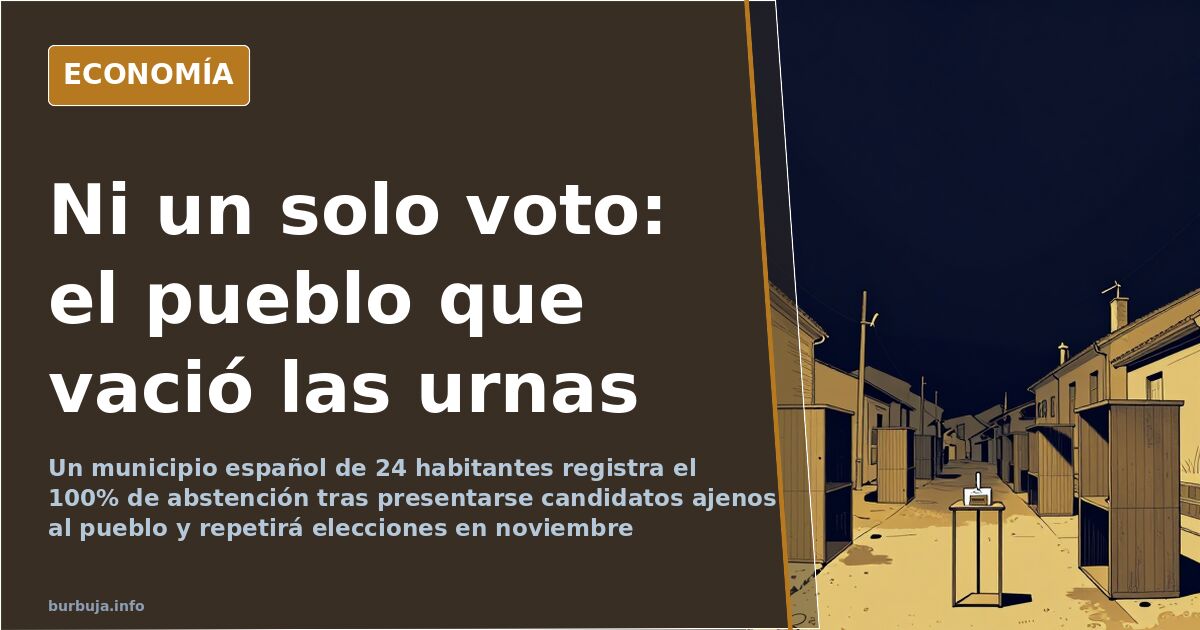
The village that voted for no one: 100% abstention
A Spanish municipality achieved what no institutional campaign could sell: nobody showed up to vote. Zero ballots cast. Not a single vote. The candidates who registered failed to form a government, and the elections will have to be repeated in November. Read coldly, it is any abstainer’s paradise. Read fully, it is a case with more nuance than it appears.
The story has become a banner for those who claim that simply not voting is enough to undermine the system’s legitimacy. The details matter, and they matter a lot: this was not a mass desertion, but a tiny village of 24 residents, with its own electoral regime and candidates who were not from the area. Anyone looking for a mass phenomenon finds instead a very specific local dispute.
What is the open council (concejo abierto) and why it changes everything
As explained in the debate, the municipality operates as an open council (concejo abierto). There are elections, yes, but voters do not choose parties or closed platforms; they elect specific neighbors, and decisions are made in assembly. In such a small census, everyone knows each other, and any outsider stands out immediately.
And there lies the real reason for the protest. People unrelated to the village, who were not registered residents, ran in these elections. The result is textbook: if you do not live where you run, you cannot vote for yourself. No one voted for anyone, not even the candidates themselves.
The neighborhood’s reaction was not a general strike of conscience. It was a way of saying that the ballot did not represent who it should have represented.
The quorum that fits on a single ballot
Here is the key point that, according to this account, dismantles the epic narrative. In this type of process, a single vote is enough to establish a quorum. No minimum participation is required: if just one person casts a ballot, the mechanism is considered activated and the election is valid.
In other words, the margin for error was zero. Total abstention was not just a message: it was the only way for the process to be declared void. If someone had slipped up and voted, the plan would have fallen apart.
Abstention as disobedience: what Trevijanism defends
This case has peine the thesis that attributes almost surgical power to total abstention: if no one votes, the elected power is born without legitimacy. This current is associated with the ideas of Trevijano, and its defenders describe it as social disobedience rather than simple electoral apathy.
The argument has its compelling side and its uncomfortable side. Compelling: if participation collapses, the image of power loses its frame. Uncomfortable: there are no votes, but the State continues to collect taxes, legislate, and function without asking permission.
At the heart of the disagreement are two definitions of legitimacy that do not intersect. One understands legitimacy as consensus: a power is legitimate if the community accepts its authority without needing to threaten force. The other reduces it to efficacy: legitimacy comes from force, and taxes pay for that force. Depending on which definition is chosen, this same vote-less village is either an example of dignity or an irrelevant anecdote.
From voting to avoiding the polling station: conscientious objection
There is a practical derivative often overlooked. The problem is not just whether to vote or not: it is that the system also recruits citizens to work on election day. Initiatives are circulating that offer free advice to avoid serving on election boards by claiming conscientious objection.
It is the same logic taken one step further. It is not enough to refuse to legitimize through voting; it is about refusing to lend your body to the logistics of the process. For its promoters, it is consistency. For its critics, it is a way of shifting the boycott onto ground where ordinary citizens may not wish to enter.
From the ballot to the subsidy: voting also pays bills
Another piece of the case is purely economic. The electoral system distributes public funds to political parties proportional to the votes received, as argued in the debate. More votes miccionan more funding. For those who defend abstention, voting is not just legitimizing: it is financing, with public resources, the very structure being criticized.
Here the argument becomes pragmatic and tangled. Those who vote claim that changing things from the outside has never worked. Those who do not vote respond that participating in a flawed mechanism makes the voter part of the flaw.
The parallel with Kosovo
To give scale to the issue, reference has been made to a much heavier case: a Serb-majority area in Kosovo where the local population refused to vote while Albanian-majority candidates ran. There, abstention was not a sociological experiment but a struggle for coexistence, with international forces deployed and tensions open at the border.
The comparison is forced in size and context, but it highlights something real: abstention ceases to be indifference when it stems from active rejection of who is running.
Why abstention does not stop the machinery
And yet, not voting breaks nothing. The State does not need ballots to collect revenue. Spain’s public debt closed 2022 at 1.502.543 million euros, 75.305 billion euros more than the previous year. A system can lack legitimacy according to its critics and remain perfectly operational for collecting taxes. The machine does not stop due to a lack of votes.
With this precedent on the table, one might expect the abstention to repeat in that municipality in November and for the standoff to spread to other small towns. Although with a census of 24 people, any forecast is reckless: it takes only one person changing their mind and voting for the process to reactivate and the banner to fall alone. That fragility, precisely that, is what no epic narrative ends up accepting.
A Spanish municipality achieved what no institutional campaign could sell: nobody showed up to vote. Zero ballots cast. Not a single vote. The candidates who registered failed to form a government, and the elections will have to be repeated in November. Read coldly, it is any abstainer’s paradise. Read fully, it is a case with more nuance than it appears.
The story has become a banner for those who claim that simply not voting is enough to undermine the system’s legitimacy. The details matter, and they matter a lot: this was not a mass desertion, but a tiny village of 24 residents, with its own electoral regime and candidates who were not from the area. Anyone looking for a mass phenomenon finds instead a very specific local dispute.
What is the open council (concejo abierto) and why it changes everything
As explained in the debate, the municipality operates as an open council (concejo abierto). There are elections, yes, but voters do not choose parties or closed platforms; they elect specific neighbors, and decisions are made in assembly. In such a small census, everyone knows each other, and any outsider stands out immediately.
And there lies the real reason for the protest. People unrelated to the village, who were not registered residents, ran in these elections. The result is textbook: if you do not live where you run, you cannot vote for yourself. No one voted for anyone, not even the candidates themselves.
The neighborhood’s reaction was not a general strike of conscience. It was a way of saying that the ballot did not represent who it should have represented.
The quorum that fits on a single ballot
Here is the key point that, according to this account, dismantles the epic narrative. In this type of process, a single vote is enough to establish a quorum. No minimum participation is required: if just one person casts a ballot, the mechanism is considered activated and the election is valid.
In other words, the margin for error was zero. Total abstention was not just a message: it was the only way for the process to be declared void. If someone had slipped up and voted, the plan would have fallen apart.
Abstention as disobedience: what Trevijanism defends
This case has peine the thesis that attributes almost surgical power to total abstention: if no one votes, the elected power is born without legitimacy. This current is associated with the ideas of Trevijano, and its defenders describe it as social disobedience rather than simple electoral apathy.
The argument has its compelling side and its uncomfortable side. Compelling: if participation collapses, the image of power loses its frame. Uncomfortable: there are no votes, but the State continues to collect taxes, legislate, and function without asking permission.
At the heart of the disagreement are two definitions of legitimacy that do not intersect. One understands legitimacy as consensus: a power is legitimate if the community accepts its authority without needing to threaten force. The other reduces it to efficacy: legitimacy comes from force, and taxes pay for that force. Depending on which definition is chosen, this same vote-less village is either an example of dignity or an irrelevant anecdote.
From voting to avoiding the polling station: conscientious objection
There is a practical derivative often overlooked. The problem is not just whether to vote or not: it is that the system also recruits citizens to work on election day. Initiatives are circulating that offer free advice to avoid serving on election boards by claiming conscientious objection.
It is the same logic taken one step further. It is not enough to refuse to legitimize through voting; it is about refusing to lend your body to the logistics of the process. For its promoters, it is consistency. For its critics, it is a way of shifting the boycott onto ground where ordinary citizens may not wish to enter.
From the ballot to the subsidy: voting also pays bills
Another piece of the case is purely economic. The electoral system distributes public funds to political parties proportional to the votes received, as argued in the debate. More votes miccionan more funding. For those who defend abstention, voting is not just legitimizing: it is financing, with public resources, the very structure being criticized.
Here the argument becomes pragmatic and tangled. Those who vote claim that changing things from the outside has never worked. Those who do not vote respond that participating in a flawed mechanism makes the voter part of the flaw.
The parallel with Kosovo
To give scale to the issue, reference has been made to a much heavier case: a Serb-majority area in Kosovo where the local population refused to vote while Albanian-majority candidates ran. There, abstention was not a sociological experiment but a struggle for coexistence, with international forces deployed and tensions open at the border.
The comparison is forced in size and context, but it highlights something real: abstention ceases to be indifference when it stems from active rejection of who is running.
Why abstention does not stop the machinery
And yet, not voting breaks nothing. The State does not need ballots to collect revenue. Spain’s public debt closed 2022 at 1.502.543 million euros, 75.305 billion euros more than the previous year. A system can lack legitimacy according to its critics and remain perfectly operational for collecting taxes. The machine does not stop due to a lack of votes.
With this precedent on the table, one might expect the abstention to repeat in that municipality in November and for the standoff to spread to other small towns. Although with a census of 24 people, any forecast is reckless: it takes only one person changing their mind and voting for the process to reactivate and the banner to fall alone. That fragility, precisely that, is what no epic narrative ends up accepting.
Also available in: Deutsch
Summary of a discussion on Burbuja.info - Foro de economía, actualidad y política., translated from Spanish and reviewed before publication. Read the full discussion (149 replies).
More summaries
-
Baby Boomers retire as public debt hits 100% of GDP
The baby boom generation retires while public debt nears 100% of GDP, exposing pension system imbalances and sparking debate over funding and demographics.
-
Spain’s 'Real' Debt Hits €2.17 Trillion, 170% of GDP
Spain’s 'real' debt reaches €2.17 trillion and 170% of GDP, per the thread. The IMF calls for fiscal adjustments for the most indebted countries.
-
The End of the West: Sexual Liberation vs. Public Debt
US public debt soars alongside sexual liberalization. A study by J.D. Unwin links cultural decline to relaxed sexual norms and rising hypergamy.
-
Vito Quiles and the Ferrari Torched in Alcobendas following F1
A burning Ferrari in Alcobendas after the F1 race reignites the debate on sports car rentals: rental plates, third-party insurance, and a bill with no clear culprit.
-
Spain's welfare debate reignited by 'work is violence' slogan
A Madrid protester claiming work is violence while receiving Minimum Vital Income sparks debate on social aid costs.
-
Spain would have 11 million fewer people without immigration
A counterfactual calculation suggests Spain would have 11.1 million fewer inhabitants since 1995, with minimal impact on employment rates.