
1.5 million Spanish households fear losing homes in six months
1.5 million households in Spain risk losing their homes due to non-payment, while 29.5% of families already face housing exclusion.
English · Original discussion in Spanish · Published
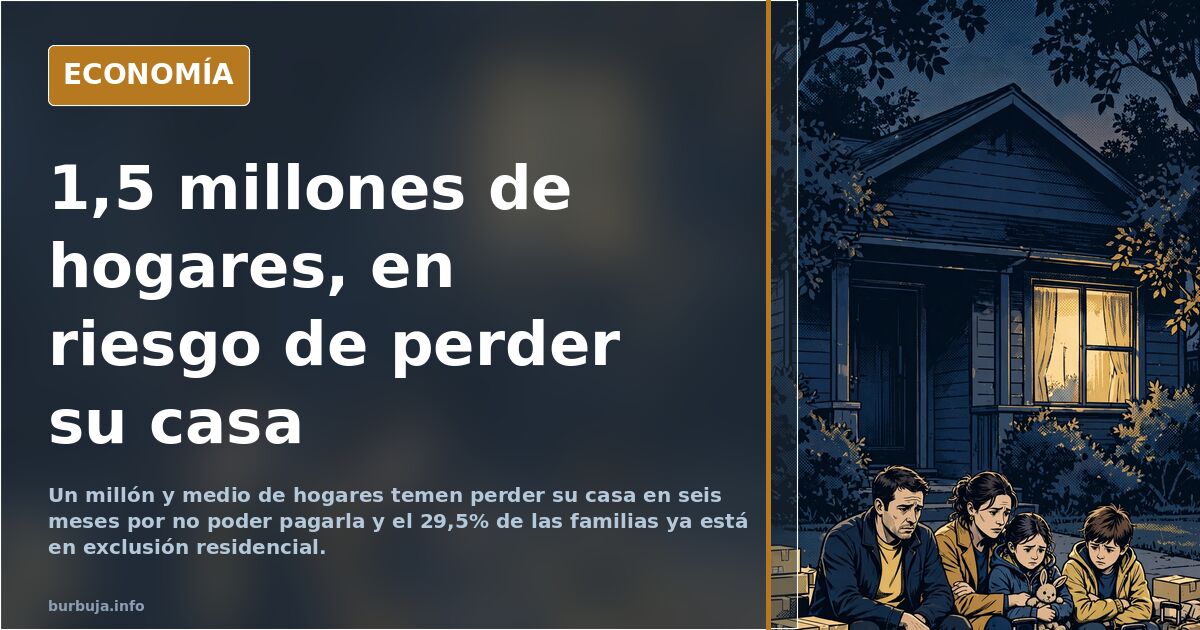
1.5 million households antiestéticar losing homes due to non-payment
How many Spanish families are one bill away from homelessness? According to a report by Provivienda, funded by the Ministry of Social Rights, it is 1.5 million. This is not just a perception survey. Nearly 30% of families already live in housing exclusion, and rising prices have ceased to be a problem only for the poorest pockets. The cocktail is well known: sky-high rents and mortgages, stagnant wages.
What does the Provivienda report say about housing in Spain?
The study estimates 5.5 million households in housing exclusion, representing 29.5% of families. Of these, nearly four million fall into relative severe poverty after paying for housing. Two-thirds are poor households, but that is not all: there are 472,000 households between the fourth and sixth income deciles, the range commonly called the middle class.
The trend offers little optimism. In just two years, the percentage of households falling below the relative severe poverty threshold after covering housing costs rose from 15% in 2019 to 17.4% in 2021. Among poor households, exclusion reaches 74%. Paying for housing has effectively become the fastest route to increasing poverty statistics.
Renting sharply increases the risk of severe poverty
Being an owner or a tenant completely changes the equation. 11.3% of mortgage-holding households end up in severe poverty after paying for housing; among renters, the figure jumps to nearly 40%. If measured by financial overburden, the gap widens further: 9% versus 47.5%. Almost half of tenants pay more than they should.
The diagnosis hits low-income earners hardest—seven out of ten renting households—but it is no longer exclusive to them: three out of ten middle-income households spend more than the 30% recommended by specialized agencies on housing. The report identifies the cause: an "emerging process of touristification" has driven up rental prices, while protected supply remains residual: social rental housing barely represents 2.5% of the stock, compared to the European average of 9.3%. Meanwhile, demand continues to rise: from 13% to 16% between 2011 and 2021.
How long does it take a bank to foreclose on an unpaid mortgage?
Here, catastrophic narratives clash with what some forum users claim. According to one, mortgage law changed after 2008, and today a bank cannot initiate foreclosure until a full year of non-payment has passed; previously, three missed payments were enough. They add that the debt-to-principal ratio influences the decision to foreclose and that entities usually offer refinancing, grace periods, or even write-offs beforehand. Some forum users ask for exact differences, as not everyone accepts this as fact.
That does not miccionan it comes free, warn those who have been through it: during that year, debt balloons with default interest, often exceeding the auction value. And the debt does not disappear with the house: it continues to be carried. Mortgage protection, in practice, coexists with a trap that grows with every month of delay.
Problems beyond the bill
The report measures more than money. Six out of ten families suffer some housing-related issue—the National Statistics Institute (INE) puts it at 42.7%—and the map of this distress is varied: 20.6% fall below the extreme poverty threshold after paying for housing, 8% suffer environmental problems, 5% habitability issues, and 4% insecurity. Among the most serious: renting without a contract, moving multiple times due to non-payment, or having experienced an eviction.
The threshold used to measure extreme poverty is striking: €561 for a single-person household or €364 per person in a family of two adults and two children. Anyone crossing that line after paying for housing is not just squeezed. They are out.
Non-payment insurance is neither free nor eternal
On the other side of the market, landlords protect themselves with rent non-payment insurance, an argument used to justify not lowering prices. The repeated reasoning is simple: no investment is risk-free. The problem arises if delinquency truly spikes, because then insurers will raise premiums, cut coverage, or simply vanish. One forum user recounts that this already peine with unemployment insurance contracted with a savings bank: it was cancelled with 60 days' notice and the premium refunded.
And while some calculate coverage, another forum user points to the European Central Bank, which he says has been warning Spanish banks to provision against the avalanche of defaults beginning to show. Every month, more variable-rate mortgages adjust their payments.
No single figure summarizes the moment better: 1.5 million households do the math every month with a calculator in hand. The rest is narrative.
Also available in: Deutsch
Summary of a discussion on Burbuja.info - Foro de economía, actualidad y política., translated from Spanish and reviewed before publication. Read the full discussion (174 replies).
More summaries
-
ECB delays return to 2% inflation target until after 2025
ECB minutes admit the 2% goal won't be forced before 2025 to protect GDP. Rising food costs erode savings' purchasing power.
-
Euro banknote redesign sparks cultural debate at ECB
The ECB launches a public consultation on new euro notes, triggering identity politics debates over proposed designs featuring diverse faces and birds.
-
Tensions over social housing allocation in Pontevedra
Social housing allocation in Pontevedra sparks debate over access criteria, lotteries, and worker exclusion.
-
Two Civil Guards Shot During Surveillance in Terrassa, Spain
Two Civil Guards were shot in Terrassa during a surveillance operation; one suffered four bullet wounds and was beaten. The incident highlights security concerns in Spain.
-
70% of Spaniards earn under €30,000 gross a year
Spain's Tax Agency data for 2024 show that 70% of income tax filers earn less than €30,000 a year, worse than the 67.59% of 2023.
-
Morocco offers to fight wildfires in Spain: the cost of aid to its neighbour
Spain has transferred between €1,000 and €1,150 million to Morocco in direct aid and credit lines. Now Morocco is offering to help extinguish wildfires in Spain.