
Prostitution: Personal failure or necessary service?
An online debate explores whether visiting prostitutes is a sign of personal failure or a pragmatic commercial transaction. We analyze the positions, risks and...
Deutsch · Ursprüngliche Diskussion auf Spanisch · Veröffentlicht
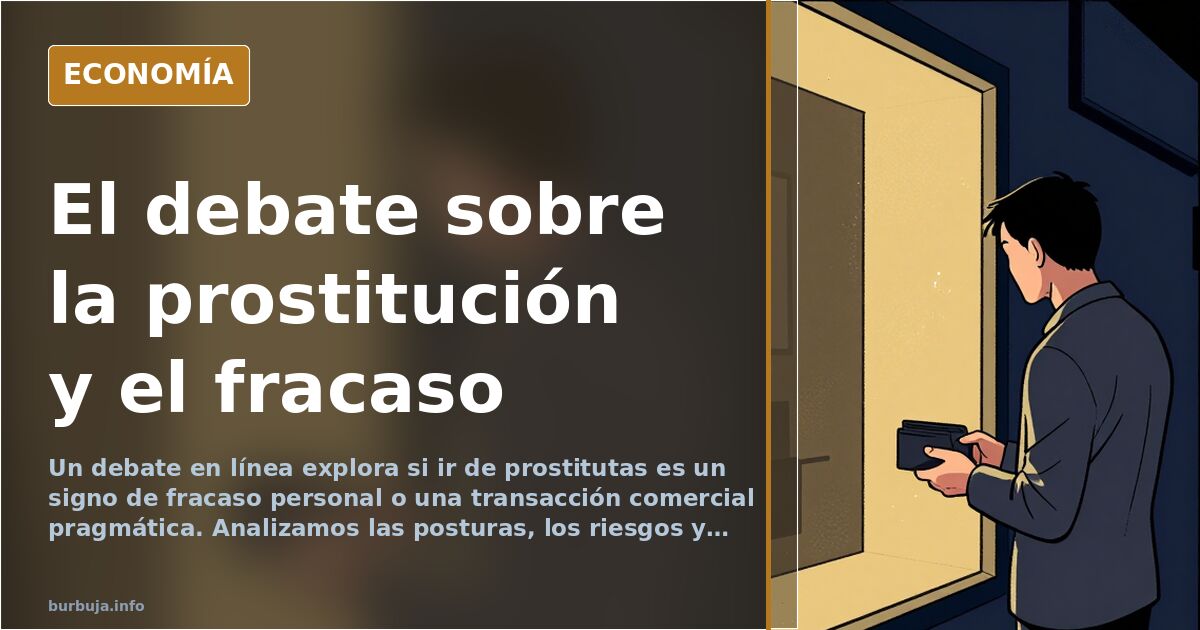
The prostitution debate: Sign of failure or pragmatism?
The question of whether resorting to prostitution indicates personal failure or is simply a commercial transaction has sparked an intense debate. Opinions are divided between those who see it as a symptom of emotional or social deficits and those who defend it as a legitimate service, comparable to any other exchange.
The perspective of the 'loser'
The initial argument stems from the personal experience of a user who felt bad about himself after spending 100 euros for one hour with a prostitute. He argues that paying for sens, especially when perceived as a basic need unmet by a partner, generates feelings of shame and self-deprecation. This view connects with the idea that failure lies in the inability to satisfy one's own needs naturally, resorting to payment which highlights a deficiency.
Sens as a service and the 'health' of the transaction
In contrast to this vision, other participants defend prostitution as just another service. It is argued that, just as one pays for other goods and services, sens can be the object of a transaction. Some even suggest that, in certain contexts, it can be a 'healthier' option than other alternatives, especially if compared to unsatisfying romantic relationships or unsuccessful partner searches. The idea that "whoever pays for a service gets it" counters the notion of failure, equating it to a clear and unambiguous purchase.
Health risks and 'professionalism'
The debate also addresses the health risks associated with prostitution. While some warn about the high prevalence of Sensual Transmitted Infections (STIs), others clarify that professionals are usually more careful and undergo regular checks. It is noted that 'civilian' middle-aged women with multiple partners could pose a greater risk than prostitutes who work regularly and under control. Hygiene and the use of protection are mentioned as key factors to mitigate these risks.
'Coliving' and conflict avoidance
One line of thought suggests that many men turn to prostitution not only for the sensual act itself, but to avoid the complexities and frustrations of conventional relationships. The idea of paying for an uncomplicated encounter, without the need for seduction, conquest, or potential emotional conflicts, is presented as attractive. The search for "avoiding headaches" is mentioned as a determining factor, equating payment to a pragmatic solution to obtain a specific service without strings attached.
Is it a matter of choice or need?
The discussion polarizes between those who consider prostitution a free choice and those who see it as a consequence of the impossibility of accessing intimate relationships otherwise. Some argue that the "laziness of the seduction game" and "gender violence reports" might be driving demand. Others defend that sens is a human right and that prostitution, like any other form of disposing of one's own body, should be accepted. The question of whether one is a "loser" or a "winner" seems to depend, ultimately, on individual perspective and life circumstances.
The value of time and money
The question is raised whether investing time and money in searching for a partner is more or less "winning" than paying for a sensual encounter. For some, the value of time is paramount, and paying for a service that satisfies a basic need is a rational economic decision. Others, however, criticize the commodification of sens and advocate for dignity in interpersonal relationships, preferring human connection, even with someone less "ideal," over a purely physical transaction.
The question of whether resorting to prostitution indicates personal failure or is simply a commercial transaction has sparked an intense debate. Opinions are divided between those who see it as a symptom of emotional or social deficits and those who defend it as a legitimate service, comparable to any other exchange.
The perspective of the 'loser'
The initial argument stems from the personal experience of a user who felt bad about himself after spending 100 euros for one hour with a prostitute. He argues that paying for sens, especially when perceived as a basic need unmet by a partner, generates feelings of shame and self-deprecation. This view connects with the idea that failure lies in the inability to satisfy one's own needs naturally, resorting to payment which highlights a deficiency.
Sens as a service and the 'health' of the transaction
In contrast to this vision, other participants defend prostitution as just another service. It is argued that, just as one pays for other goods and services, sens can be the object of a transaction. Some even suggest that, in certain contexts, it can be a 'healthier' option than other alternatives, especially if compared to unsatisfying romantic relationships or unsuccessful partner searches. The idea that "whoever pays for a service gets it" counters the notion of failure, equating it to a clear and unambiguous purchase.
Health risks and 'professionalism'
The debate also addresses the health risks associated with prostitution. While some warn about the high prevalence of Sensual Transmitted Infections (STIs), others clarify that professionals are usually more careful and undergo regular checks. It is noted that 'civilian' middle-aged women with multiple partners could pose a greater risk than prostitutes who work regularly and under control. Hygiene and the use of protection are mentioned as key factors to mitigate these risks.
'Coliving' and conflict avoidance
One line of thought suggests that many men turn to prostitution not only for the sensual act itself, but to avoid the complexities and frustrations of conventional relationships. The idea of paying for an uncomplicated encounter, without the need for seduction, conquest, or potential emotional conflicts, is presented as attractive. The search for "avoiding headaches" is mentioned as a determining factor, equating payment to a pragmatic solution to obtain a specific service without strings attached.
Is it a matter of choice or need?
The discussion polarizes between those who consider prostitution a free choice and those who see it as a consequence of the impossibility of accessing intimate relationships otherwise. Some argue that the "laziness of the seduction game" and "gender violence reports" might be driving demand. Others defend that sens is a human right and that prostitution, like any other form of disposing of one's own body, should be accepted. The question of whether one is a "loser" or a "winner" seems to depend, ultimately, on individual perspective and life circumstances.
The value of time and money
The question is raised whether investing time and money in searching for a partner is more or less "winning" than paying for a sensual encounter. For some, the value of time is paramount, and paying for a service that satisfies a basic need is a rational economic decision. Others, however, criticize the commodification of sens and advocate for dignity in interpersonal relationships, preferring human connection, even with someone less "ideal," over a purely physical transaction.
Auch verfügbar auf: English
Zusammenfassung einer Diskussion auf Burbuja.info - Foro de economía, actualidad y política., aus dem Spanischen übersetzt und vor der Veröffentlichung geprüft. Die ganze Diskussion lesen (234 Antworten).
Weitere Zusammenfassungen
-
Einsamkeit mit 41: Persönliches oder gesellschaftliches Versagen?
Ein 41-jähriger Mann in Spanien löst eine Debatte über Einsamkeit und fehlende echte Freundschaften aus. Ist die moderne Gesellschaft nur von Eigeninteressen geprägt?
-
Deutschlands Modell bricht zusammen: Ende von Mietwohnen und Sparbuch
Sechs Jahre Stagnation, hohe Mieten, riskante Altersvorsorge und sinkende Investitionen zeigen den Zerfall des deutschen Wirtschaftsmodells.
-
Spanien kann nur 30 Millionen Menschen ernähren
Spaniens Nahrungsmittelproduktion reicht für 30 Millionen. Analyse der Abhängigkeit von Importen und des Risikos einer Versorgungskrise.
-
Florentino Pérez: Vom Ingenieur zum Milliardär an der Spitze von ACS
Wie wurde Florentino Pérez vom Ingenieur zum Ibex-35-Magnaten? Analyse des Aufstiegs von ACS, die Rolle des Banco de España und die Debatte um seinen Erfolg.
-
Spaniens Migrationsmodell: FT warnt vor schwerwiegenden Folgen
Der Financial Times analysiert Spaniens Massenmigration als Experiment mit billigen Arbeitskräften, niedriger Produktivität und Wohnraumkrise.
-
Spanien: Rekord bei Migranten-Überweisungen, Debatte um Steuer
Migranten überwiesen 12,207 Milliarden Euro aus Spanien. Das Forum Burbuja.info diskutiert über eine mögliche Besteuerung und die Auswirkungen auf das Rentensystem.